Trans-dimensional Voronoi Modeling
Adaptive geometry inference in which both the model structure and the number of parameters are learned from data.
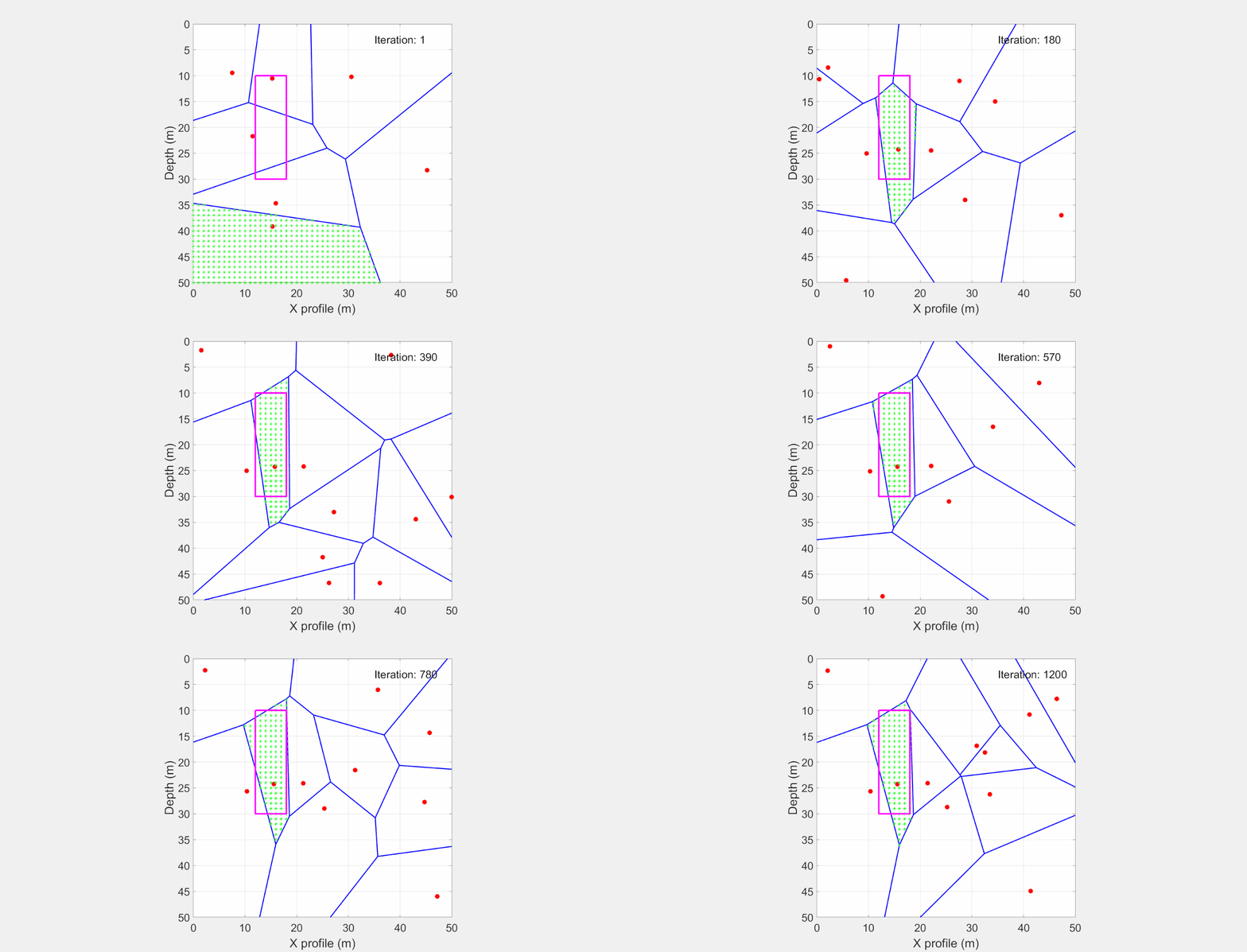
Voronoi diagrams offer a flexible way to represent spatial structure, especially when the true geometry of a target region is unknown. In this project, I used trans-dimensional modeling to let the number and placement of Voronoi nodes change during inference rather than fixing them in advance. That makes the representation more data-driven and less dependent on arbitrary design choices.
The animated example shows how a simple target geometry can emerge from iterative updates to the Voronoi partition. Instead of fitting a rigid mesh or a predefined grid, the model adapts its complexity to the information content of the observations. This is especially valuable when the goal is to capture anomalies, boundaries, or localized structure without over-parameterizing the problem.
Methods like this sit at the intersection of geometry, Bayesian inference, and inverse problems. They are useful in geoscience, anomaly detection, and any setting where the model itself should be inferred rather than assumed. This project helped shape my later work on adaptive partitioning and hierarchical spatial parameterization.