3D Bayesian Inversion for Subsurface Modeling
Probabilistic earth modeling with adaptive parameterization, correlated-noise estimation, and uncertainty-aware interpretation.
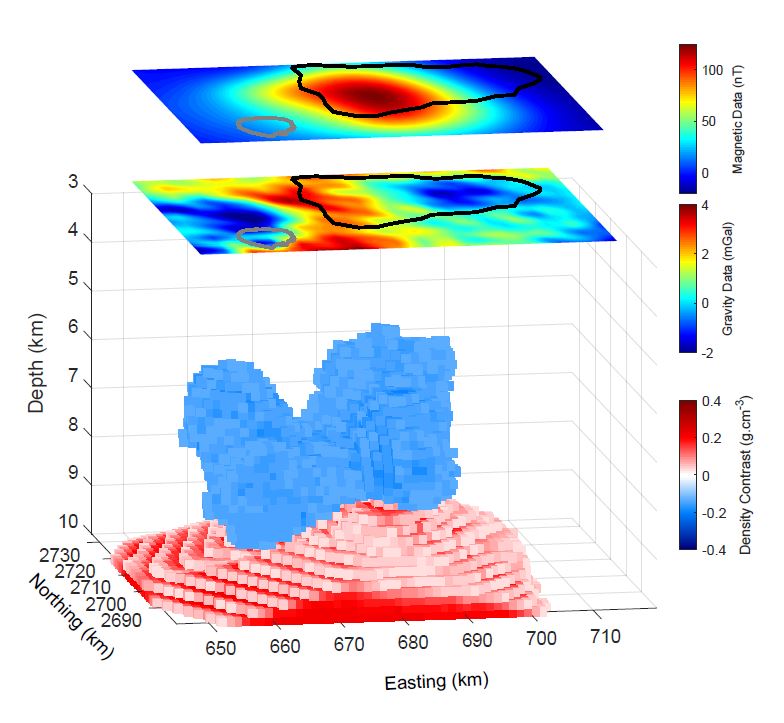
This project addresses a central challenge in geophysical inversion: how to recover meaningful 3D subsurface structure from limited and noisy gravity and magnetic observations. Traditional regularized inversions often smooth away the very structures that matter most for interpretation. I developed a nonlinear Bayesian framework that lets model complexity adapt locally to the information content of the data.
The method combines trans-dimensional partitioning with hierarchical model components and correlated-noise estimation. Instead of relying on a single fixed discretization, the inversion updates its parameterization as sampling progresses. That helps reduce unnecessary model complexity while preserving sharp, geologically meaningful structure where the data support it.
The workflow was designed for large-scale 3D problems, so computational efficiency was equally important. Wavelet compression, adaptive parameterization, and parsimonious modeling made it practical to sample posterior model ensembles and quantify uncertainty rather than produce only a single deterministic result.
This work was published in Geophysical Journal International and remains one of the core research threads behind my later work on adaptive geometry, uncertainty estimation, and spatial ML.